Emerging Markets: South America
The state of cannabis in Uruguay, Colombia, & Argentina
Since Uruguay legalized 2013, South America has emerged as a major player in the global cannabis market.
The region's progressive stance on cannabis legislation, coupled with its favorable climate and low production costs, has attracted significant interest from investors and businesses worldwide.
We continue our series on emerging markets by diving into the current state of cannabis in the continent’s leading countries—Uruguay, Colombia, and Argentina—providing an overview of the legal landscape, state of the industry, and predictions for the future.

Uruguay
Uruguay made history by becoming the first country in the world to fully legalize cannabis.
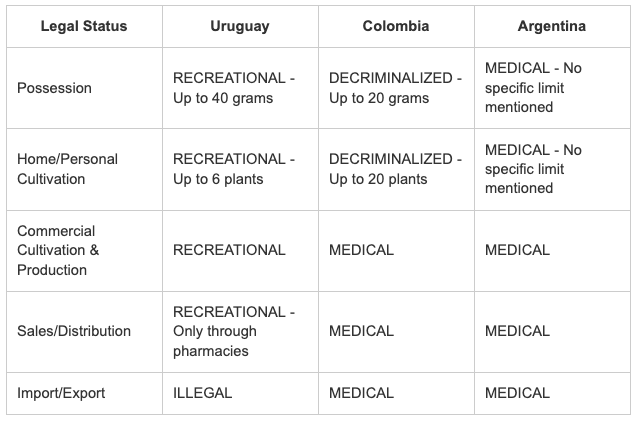
The law allows residents aged 18 and over to purchase up to 40 grams of cannabis per month from licensed pharmacies, cultivate up to six plants at home, and join cannabis clubs where members can collectively grow plants.
The country's cannabis law also established a regulatory body, the Institute for the Regulation and Control of Cannabis (IRCCA), to oversee the industry. However, despite its progressive legislation, Uruguay's cannabis market has faced several challenges familiar to other legal markets, including banking restrictions and limited market access.
Nevertheless, the country remains a global pioneer in cannabis legalization, setting a precedent for other nations to follow.
Colombia
Known for its ideal climate and rich agricultural history, Colombia has also made significant strides in cannabis legislation.
In 2015, the country legalized medical cannabis, and in 2021, President Ivan Duque signed a decree expanding the medical cannabis industry, allowing the export of dried flower, and permitting the manufacture, export, use, and marketing of cannabis derivatives, such as oils and creams.
"[Colombia] created a license structure for production, they just never created the structure for sale and distribution," explains Wesley Donahoe, fractional CMO and international cannabis advisor whose clients are optimistic about Colombia.
"There's all these people trying to get into the market and spending a lot of money building out labs and cultivation...But there's no legal market here. And they don't know when it's going to happen...they're just burning money waiting for the government to say, "Okay, you can sell it now"...They can export if they can get the license for it, but other than that, they're stuck."
While recreational cannabis remains illegal, the possession of small amounts for personal use has been decriminalized.
"Drugs are just so accepted here in general," Donahoe remarks of Colombia's attitude towards enforcement as a whole. "Everywhere you look, everyone's snorting...[right] in front of the cops...Nobody cares...It's super casual...And that's their attitude on hard drugs. So, when it comes to weed, it doesn't seem like that's what they're worried about."
Argentina
In Argentina, medical cannabis has been legal since 2017, but recreational use remains illegal.
While medical use was legalized, recreational use and home cultivation remain illegal. In 2020, a decree made medical access easier—granting access for any medical condition— and also gave patients the right to grow at home for medical purposes in 2020.
Like Uruguay, distribution is limited to pharmacies, but the country has also made significant progress in establishing a cannabis export industry for international distribution in the future.
Despite the current limits of a medical-only cannabis market, Argentina is in focused on the future, anticipating broader legalization.
South America's views on cannabis are rapidly evolving, and Uruguay, Colombia, and Argentina are leading the way.
While each country has a unique legal framework and industry, they all share a progressive stance towards legalization and a commitment to the economic potential of the cannabis industry.
Disclaimer: Remember, this article is not legal advice.
Always check current local laws when dealing with cannabis.
Subscribe to our Substack to receive new content automatically
This article is featured in Vol. 6 of The ETHOS Magazine.
Grab a collector's edition of the ETHOS magazine in print HERE.