Sharkmouse Farms: Better than 'Close Enough'
DATA-DRIVEN CULTIVATION WITH ONTARIO'S FAVORITE CANNABIS COUPLE
1 MILLION VIEWS.
When Justin Michaelov and Nicole Michaelov—the Canadian cannabis couple behind Sharkmouse Farms—woke up on July 25th, 2022, they didn’t expect to find their most recent post on trimming had gone viral, crossing the million views mark on a single reel for the first time.
“I normally put a lot of effort into the write up; that day, I didn’t have it in me,” reflects Justin in astonishment as the views continue to climb.
It was trim day, and he wasn’t motivated to make a “fun, flashy reel,” and was simply getting the trimmer ready and decided to do a basic video; just “trimming, no effort, no science, no data,” unlike most of the content you’ll find on the Sharkmouse page.
“Then your reel has 12,000 likes. Then 25,0000. Now, like 60k… then all of a sudden, High Times posted one of our reels and then all of a sudden posts started getting taken down by Instagram and we were getting next to no engagement,” finishes Justin, illustrating the daily rollercoaster they ride by sharing educational cannabis content on social media.
"Sharkmouse Farms is an educational platform designed to empower growers to produce high quality harvests at home; ‘bring home the science of growing.’"
But this cannabis couple on a mission to “bring home the science of growing” didn’t start in a grow.
Follow their journey from consumer to cultivator—and online cannabis couple powerhouse—to learn why they’re putting in the work to bring the science into home grows.
EARLY LIFE
“I was a transient teenager,” begins Justin, “bouncing between friends’ homes with no stable home life. When I was 17, I said I would give it a shot on my own.”
Shortly thereafter, he got a job at a restaurant that Nicole was working at, and the two clicked instantly, moving in with each other within a month or so of meeting. Both were “enthusiastic cannabis smokers” and bonded over the different aspects of smoking, and her brother’s access to quality product.
“Her brother was what we would consider at time ‘connoisseur’...Back when you’d only heard about Alaskan Thunderfuck or Blueberry, he was the guy who could get it.”
The pair learned a lot from him, and became enthralled with the finer qualities of cannabis. The seed had been planted.
“My brother was passionate,” Nicole continues. “Two years ago, he lost his battle with brain cancer, and since then, we have delved even more into [growing]. It became much more of a passionate purpose for us.”
“Prior to his diagnosis, we were just doing the home grow thing,” Justin says.
They were getting the best info they could off of various internet forums, and scraping by with information passed from friends and Nicole’s brother, who was a big driver for an extreme passion. After his passing, they both were looking for purpose, and found it in educating themselves and others about how to produce the highest quality harvests at home.
“We started to focus on how to become the absolute best at this in his honor.”
FROM CORPORATE TO CANNABIS
Prior to cannabis, Shark worked in loss prevention for corporations like Amazon, Lowes, and even Trump Tower, but it was an existence that paid bills for a life they didn’t have time to live.
“Corporate loss prevention was an existence that did not fulfill us,” Justin explains.
“We each spent 18 hours a day commuting and working in Toronto. We weren’t home to see the kids.”
“We were paying the mortgage and staying afloat,” Nicole adds.
“We were just scraping by,” Justin says. “We worked all the time. By 9pm, we were exhausted, the kids are in bed, and the next morning we are back on the highway at some hotel or some warehouse.”
Five years ago, they started saving for and eventually purchased a cottage, a new life, and space to grow.
“Why not go buy a cottage? So we bought a cottage,” recalls Justin of the decision to do so amidst the global shutdown. “With the extra time, what better time to go all in [on growing]?”
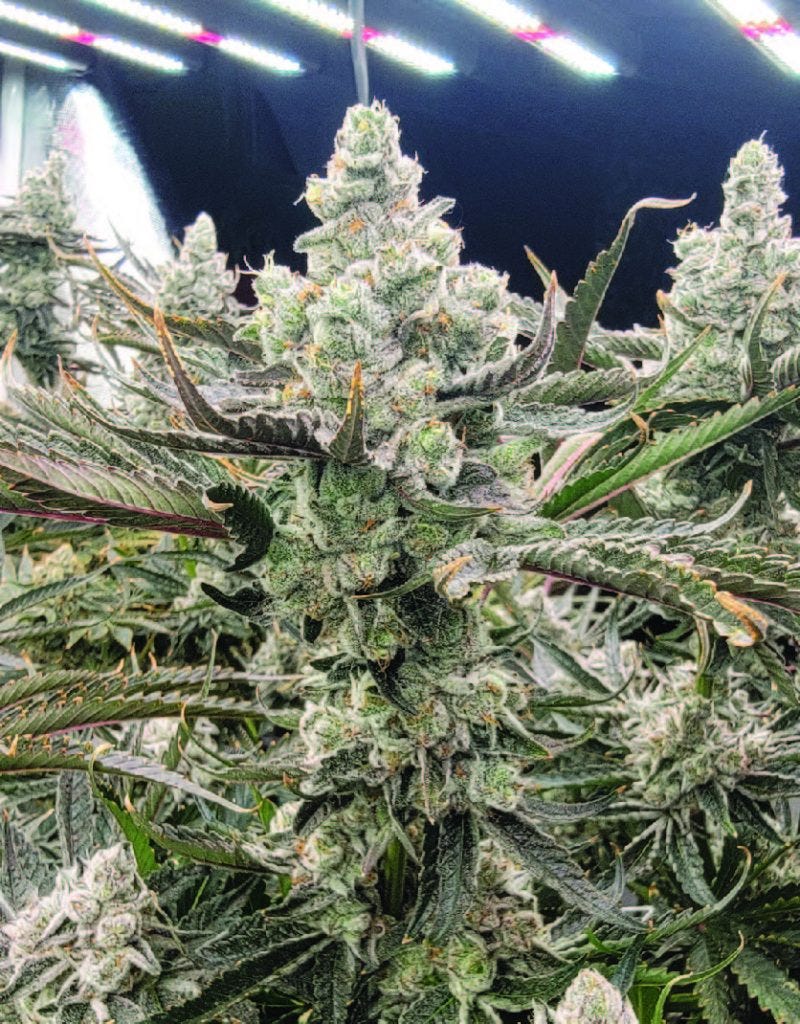
“And it's something we absolutely love,” Nicole says.
“Since the day we met, we have loved working together,” Justin says of their work-life partnership.
“Living in the city wasn't an option. We were at different ends of the city for work, and it was incompatible with how we wanted the kids to grow up; it made having a sense of family hard.
Moving to the cottage allowed them to live in the wilderness, focus on sustainability, and teach their children about nature in a way that was impossible in the city.
“We taught our kids about gardening and flowers. We live on acreage with untouched woods and beautiful wilderness where they can play like we did as kids,” he explains. “We learn about growing our own food, sustainability and land husbandry, all of the things that were impossible in a 30x90’ flat in Toronto. That is the basis of everything we are trying to do.”
Sustainability not only in practice, but in persistence.
“We have five rescue dogs–all with quirky personalities. Mouser (German for mouse) is our youngest and any time there was cheese around, she chomped at the air like a shark, like a little shark mouse.”
Hence, Sharkmouse Farms, the brand that has evolved from their efforts.
“I found it cute, but the more I have thought about it, the more it developed to have a substantial meaning to us as an ethos:
“You can be a little guy and swim with the big sharks in the deep end; you’re not relegated to your position as some small home grower. You have to jump in and go get it.”
OVERCOMING STEREOTYPES
While Justin’s page (@SharkmouseFarms) is heavy on grow content and science-based education, Nicole’s page (@flow3rfox2.0) is the opposite, dealing with mental health and breaking the stigma of moms that consume cannabis.
“I don’t do the education; I deal with more of the mental health aspect,” she explains.
“I was on pharmaceuticals and able to come off everything through cannabis, gardening, and exercise…I work to break stigmas as a mom because, as a mom, I am judged immensely. It’s unbelievable how people can view cannabis as heroin [for moms]. I try to normalize it to make people see.”
“I have a relatively good handle on the social media aspect, but one thing I am lacking is personability, humility, and tenderness,” he concedes.
“It’s hard for me not to alienate newer or inexperienced growers with info on drybacks and calculating volume content. As a new grower, that can be a lot to take in and overwhelming. I do my best to cater to all experience levels, but she’s able to make it so they don't feel alone in a pool of sharks; they have a connection point, especially when she's in the comments engaging. It makes newer growers feel more comfortable to start engaging and being part of the conversation.”
Their distinctive styles, and content, have a symbiotic effect on their audiences, offering two versions of the same story they are writing online.
“It evolved naturally, more so than people realized,” they both concede. “People will say, ‘Great work, Justin or Shark,’ meanwhile she’s hand-watering plants six times a day while I push a button on the Trollmaster and say, ‘I’m out to lunch.’...but I can’t do this by myself.”
Even as a couple, they have distinctly different roles and approaches to growing cannabis.
“We have very defined functions,” Justin explains. “I am the planner and integrate different strategies, looking for different phenos and cuts, and making relationships with breeders…She’s in here putting up grunt work, measuring runoff, doing all of those laborious tasks that people don't see, that aren’t glamorous and don't flash on screen without transitions.”
CATERING TO ALGORITHMS: THE SCIENCE BEHIND SHARKMOUSE FARMS
Justin and Nicole have established themselves on social media by regularly experimenting with new ways to share educational content and scientific insights, but they also have to game the algorithms.
“My two most successful platforms—Instagram and Facebook—I have [thousands] of followers on….unless you’re growing tomatoes, forget about [TikTok]. I started it, got 1700 followers my first day, and then got taken down.”
Shark’s approach is scientific and methodical, while Nicole’s page is about having “as much fun as we can.”
“From our perspective, short, digestible, easy-to-watch and easy-to-navigate information works best on] a platform like Instagram…I can get everything out that I need to not overwhelm [the viewer] while also appealing to the algorithm’s distribution of that content.”
Nicole is quick to point out that you won’t find common cannabis content, words, and tags on either of their pages; this is deliberate.
“You have to be careful with words and tags,” she cautions. “Our posts don’t say cannabis, we run giveaways on a different page, and there’s no smoking on our pages.”
“I do my best on Sharkmouse Farms to navigate within a professional standard for what instagram is looking at,” he adds.
But getting deleted after all of that time and money invested in building an audience is a big concern.
“We have built such a big following and heavily invested our infrastructure around such an unstable platform. You never know. You could wake up and ‘bye bye account.’”
For this reason, they are looking at expanding to other media platforms including Youtube, Twitter, and an email list.
“We’re just creating backup accounts in case the inevitable happens. Our focus is that we have to have the ability to maintain.
In the meantime, they’re playing the game like everyone else: figuring out the rules and boosting their reach by any means necessary.
“It’s been an evolution over the course of our experience. I used to put ‘Cindy 99’ and ‘Day 54’ and hashtags and stuff… it was a mess all over the place…[Lately], I have been able to manipulate the algorithm through figuring out what types of videos it would push to audiences: the length of the video, the audio…the more I learned how to utilize that, the more I learned what it was the people that were watching those videos were looking for.
“The [Sharkmouse] videos are irrelevant to 50% of the followers; they are there for the value in the caption.”
Nicole’s page focuses on value within the media, while Shark’s page focuses on calculations and the latest data from peer reviewed papers. When that becomes too much, “go to something stupid and silly” like Nicole’s page.
“A lot of people reach out and love that they can go to one page or the other,” she says.
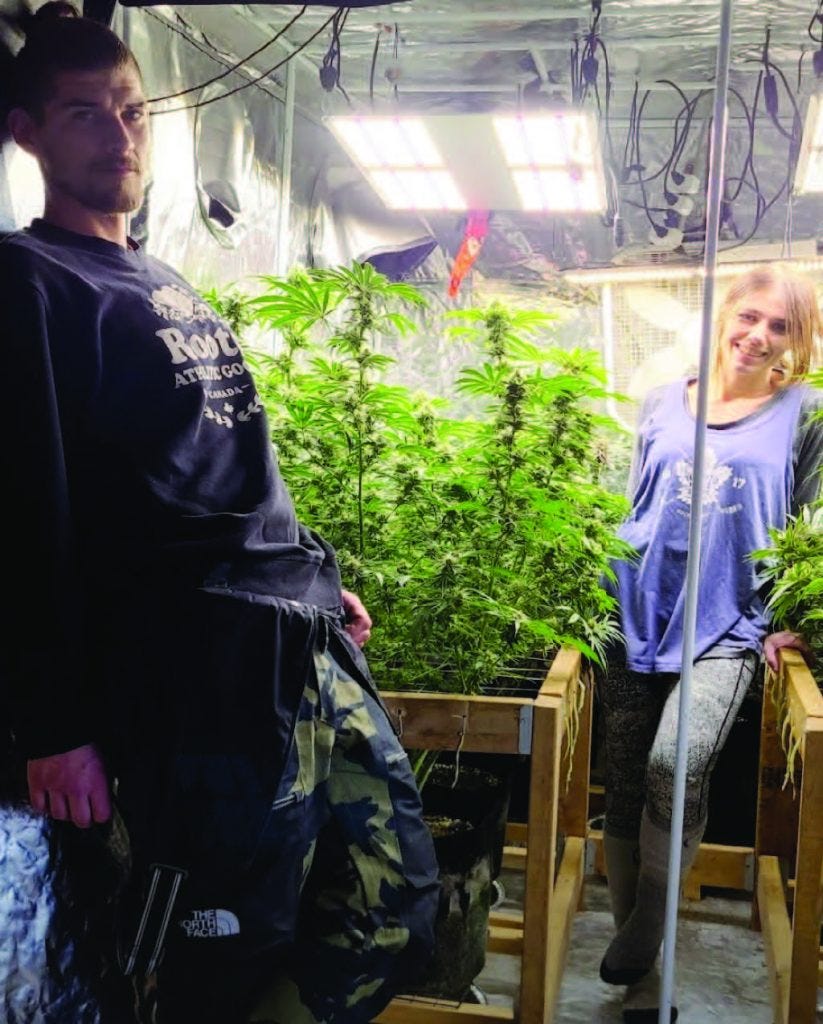
“My biggest focus is communicating complex topics in a way where this hillbilly in his house in Kawartha Lakes, Ontario can understand him,” Justin adds while raising his hand.
The two work together to craft posts, ensuring that concepts are clearly stated and easy to understand.
“I read my posts to Nicole. This is my litmus test: if she doesn’t get it, I don’t post it.”
While Nicole is a very visual learner, and her content reflects that, Justin’s value lies not in his videos, but the captions that accompany them.
“The videos appease the algorithm; the captions are what they are coming to gain; the videos are specifically designed to appease what instagram is looking for and nothing more.”
One big difference between the couple’s content and other growers is that you won’t find opinions mixed in with the research.
“We offer currently available research and nothing more. You will see progression in things where we have had to adjust with new available information,” Justin openly admits.
“We are learning, and we show that we are learning,” adds Nicole.
The biggest problem starting out as a grower is access to reliable information, and that’s the hurdle they are working to overcome.
“I think that's a barrier to entry for a lot of people,” Justin says. “If they don't have access to information, there goes another potential great cultivator.”
Further, when you can find the information, it’s incomplete.
“Oftentimes, when you go to find information on cultivation in particular, you get the how’s, but you never get the why…You have to start with a basic understanding of plant biology and work through the issues your plant may be experiencing…you need to understand how a plant works, not just the solution to your problem.”
“I think the whole point of what we are doing is to offer you the knowledge to repeat the process over and over and over again, using the best information available…and that’s where a lot of our popularity stems from.”
Justin’s content seeks to inform recreational cultivators that have been underserved by manufacturers and breeders.
“There is a wide gap in how the hobby or recreational cultivator has been served over the last 10 years from a manufacturer perspective and a breeder perspective,” Justin explains.
“We have always been considered second tier; ‘we will get to you when we get to you.’ This has left [hobby growers] stuck with five year old LED technology and companies like Gavita that said they would not make lights for home cultivators because there’s no money in that. I help show that there is a valuable market to be had here. That there are cultivators who will utilize a fully automated system, growers who will progress from a tent to an isolated flower room because they have access to the information and tools to do so.
In addition to market offerings, the couple has seen firsthand how differently these brands treat growers based on their social media status.
“If I’m a hobby cultivator on instagram with 300 followers and I reach out to XYZ cannabis corporation with 20k followers–”
“You won’t get seen,” interjects Nicole. “I’m not seen. But he can go in a second and get a response.”
“There is this cloak of masculinity and ‘alpha dog’ in [this space] where information is closely guarded and everything is proprietary; I don't believe that’s the case. There's enough food for everyone to eat,” Justin muses.
“Inspire people to grow,” Nicole adds. “You can do this at home, with a full house, with kids. There’s sustainable, quality medicine available to you without being entangled with corporate manufacturers.”
SIMILARITIES BETWEEN CANADIAN CANNABIS & BEER
Both Nicole and Justin started as medical patients, shopping at licensed dispensaries from licensed farmers, but were disappointed with the quality and outraged by the prices.
“The quality first and foremost is awful,” she begins. “The prices are outrageous—$65-70 for 3.5 grams—I don't know who can afford that.”
Adding context, Justin explains that, like beer in the ‘70s, Canada’s systems end up creating monopolies at the consumer’s expense.
“In Canada specifically, there are 17 flavors of beer but they are all from the same three big dogs. It’s all the same product. And that’s happening now in cannabis.”
But, rather than “play the game” with these monopolies, Justin and Nicole opted to play a different game entirely: that of the science-based hobby grower, demonstrating by example.
“I think we will get to a point where the [cannabis] industry looks like the craft beer market today by educating the consumer,” he explains.
“People go into dispensaries and are happy to pay $120 for their ounce…the only thing they have to go off of is label testing and what they are sold, which is often mass produced at outdoor facilities and then packaged….When the consumer doesn’t know any better, they go home and think, ‘This is awesome’ but they’ve never had the education on terpene profiles, flavonoids, what the entourage effect can do for you therapeutically, or even what’s available as far as different combinations. Once they do, they become more demanding.
“Through educating the consumer, we are eventually primed to change how the market operates from a corporate stranglehold to what we see in the craft beer market.”
Everyone in Ontario—the province where Justin and Nicole live—can grow four plants per household, but cities like Manitoba are pushing back and trying to lobby against the arbitrary constitutional limits as the popularity of hobby cultivation has skyrocketed since 2018.
“Between the two of us, we are allowed to grow 49 plants, but we are not allowed to sell any,” Nicole explains, acknowledging that cannabis needs vary person to person.
“It’s an arbitrary limit; Joe could be medicated off a gram a day, Steve may need 49 grams a day. The government of Canada is most certainly not in a position to say.”
FROM HUMBLE BEGINNINGS TO HIGH TECH HOBBY GROWERS
If you were to visit either Justin or Nicole’s social pages, you’d likely see a setup built from parts common in commercial facilities—far from your average home grow setup, but they didn’t start with all of the bells and whistles.
“We came home with a clone, put it on the dryer, and foiled the inside of one of our cupboards,” recalls Nicole of their first grow space.
“We used the snake’s heat lamp because it was infrared and a sand pail bucket. Because we eventually figured out that a plant needs light, we would put it outside in the daytime and bring it back inside at night. Then, we learned about spider mites…so that was fun,” Nicole laughs before adding “We killed that plant.”
After that, the pair decided it was time to level up.
“The next [clone], we got a tent…a 3x3’ ‘Amazon Special’ that came with a 2-stage LED…it had aluminum wire holding it up; just a disaster…But we loved it.”
From there, piece by piece, the two started getting more into growing, and more invested in upgrading their setup from a 3x3 to a 6x8 tent.
Laughing, Justin recalls having to ask Nicole’s permission when all of the new equipment showed up one day without explanation.
“Everything I thought I needed showed up one day and I had to explain it to her…as awful as [the early] setup was, we started producing quality medicine just based on reading and getting more involved in the process.”
Justin stumbled upon a wealth of information in the form of open library universities, and admits to losing a few nights deep down the rabbit hole of peer-reviewed papers.
“I digested so many papers that my eyes started falling out of my head…I didn’t know all of this information existed, let alone was available. I became enthralled, and from there started dialing in our efforts.”
Rather than diving straight down the rabbit hole, Justin advises starting simple, with the basic concepts, the way children learn.
“I suggest people start with basic plant biology books for children. You can’t really get into the process if you don't understand how plants work in general. People want to start a grow tent and don’t understand how photosynthesis works. You don't need a PHD in botany, but having a rudimentary understanding helps…it would be like trying to build a racecar without really understanding how an engine works.”
While anyone can put a seed in the ground and it’s likely to pop up, Justin and Nicole’s goal is to start growers off with a foundation to build upwards, from seed to opening the jar post-cure.
AN EVER-EVOLVING PROCESS
Like all aspects of a grow, the more you learn, the more there is to tweak and test, especially if your goal is constant improvement.
“We are not trying to get close enough; we are trying to get the best,” reminds Justin. “The way to do that is to understand what is happening during the process.”
Each process is done for a reason, not just for the sake of doing it.
“We are not trying to dry the plant for drying’s sake. We are doing it for a specific purpose: to ensure we are not burning off volatiles…that’s the whole purpose of low and slow. You have to dehydrate slow enough to allow it to break down sugars and starches and leave us only with the good stuff… Traditionally, we drag that process out as long as possible, but science says that’s not necessary, and that degradation happens in four days of darkness at ideal conditions.”
With each new piece of knowledge, the Sharkmouse approach is fine-tuned.
“Osmotic pressure isn’t a guessing game. You can calculate the number you need to pull the exact amount of water out… you’re not guessing. There are metrics and science [to this].”
DATA-DRIVEN EDUCATORS What started as a hobby has grown into a brand that is gradually gaining attention among growers of all skill levels, and both Justin and Nicole see Sharkmouse Farms as an educational platform to continue to inform growers’ efforts.
“We don’t envision having our own packs of flower in dispensaries… We don’t consider ourselves cultivators; we consider ourselves educators.”
This nuance is important to understanding how they approach growing and what drives their efforts.
“We want to be recognized as the seal of approval for whatever it is they are doing; we want to know that XYZ farms cultivated through Sharkmouse Farms science…where you can look at a brand and know that it has been approved by Shark’s methods or course or branding or whatever direction we take that. We want to be recognized as the authority on Data-Driven Cultivation.”
They’ve even partnered up with big names like CannaCribs and Jungle Boys to produce a web series (launching Winter 2023) focused on helping existing growers level up their efforts.
“The premise is to take relatively experienced growers that know they could be [better], and show them how use automated irrigation systems and data analysis and proper HVAC to take their efforts to the next level….for people who want to know ‘How do we go from a tent in the basement to what Shark is doing.”
One of the couple’s biggest advantages in having two sides to the growing spectrum is the ability to offer insight (and content) on a variety of different methods—they grow indoors and outdoors, from seed and from clone, fems and regs, with organics and minerals, in soil and coco, both hand watered and irrigated—with something for everyone.
“All of our spaces are set up a little bit differently, with a little different methods so we don't alienate [audiences],” Nicole explains.
“We try to amalgamate as many different practices to incorporate as many of our followers because [the process] depends entirely on what we are using that space for.”

While their shared love for the plant (and public persona as a cannabis couple) has only amplified their personal relationship, the two acknowledge that their situation is rare.
“We don’t find many other couples [like us],” explains Nicole. “We actually hear often about one partner complaining about the other partner who wants them to stop growing.”
“To find a couple that both grow, let alone be on a social together…we are a bit of unicorn,” admits Justin.
Outside of the grow, Justin and Nicole have just as much going on, raising five dogs, five kids, five cats, and “a couple more than five plants,” and that involves a profound amount of respect for each other’s needs.
“We have to respect one another’s need for time to balance both work and life,” begins Justin. “If you have to go water, I understand, or if I have to go check the data on the irrigation, she understands.”
“We love growing because it gives us a break,” Nicole says.
“We have found not only what drives us, we found what motivates others, and that continues to inspire us, knowing what it feels like to be on the other side,” he adds.
“I had anticipated not only push back but potential ridicule from the ‘idiot tent grower dancing in his basement,’” Justin says of his efforts to create content that both helped growers and satisfied social algorithms.” But the reception I received from even the biggest names in cannabis has been overwhelmingly supportive.”
GROW FOR THE BEST, NOT ‘CLOSE ENOUGH’
When you look at their setup, it may look “overkill for a home grow,” according to Shark, but the couple understands the unique needs of their niche: best, not budget.
“One thing I said when we started was that I wasn’t going to cater to what followers’ budgets were or what I thought they could get away with. I was going to do the very best possible and show them what the possibilities were…Some of the biggest mistakes I've made were buying $130 dehumidifier thinking it would do the job, and then having to buy a $200 [replacement], then a $300 [replacement], etc. when I could have spent all that money and overdone it in the first place.”
According to Shark, the three most critical aspects of a successful grow are the genetics, the environment, and the investment (both money and time).
“If you can't commit to those, you will only get what your limiting factor allows.”
“It is a lot of money,” concedes Shark of the investment in their setup. “This equipment is by far priced by niche as opposed to its actual value in most cases. These manufacturers know that they are committed to a specific demographic that is willing to pay for the fact that it is cannabis cultivation equipment.”
Unlike Shark, Nicole was “diametrically opposed” to investing in high end equipment.
“I was fully against automation,” she begins. “I was trying to keep up with it [by hand watering], but what I saw coming out of the first [automated] run, I can’t keep up with it…it gives you the freedom to do other stuff in the grow.
“It is absolutely possible to get high quality medicine at home [without automation], but it will eat most of the day and you will get ‘close enough.’ You won’t get perfect. Human beings aren't granular enough to be capable of managing that many tasks 24 hours a day; it’s impossible.
ADVICE TO GROWERS OF ALL LEVELS: KEEP LEARNING
Whether you’re a first timer or you’ve got a few cycles under your belt, Justin and Nicole’s biggest piece of advice is to keep learning and keep trying to get better.
“Failure is worth two experience points,” says Justin. “You need to make mistakes to learn…When you win, you celebrate and move on. But when you fail, you tend to feel those lessons…. Take failures for what they are, which is gold.”
That, and make sure to take the time to understand and invest in the proper equipment.
“[At first], we used a light that was sponsored, but it had diodes that were always on,” explains Nicole. “Everyone will tell you something, you need to do your own research. While it is important to ask questions and interact with experience, take outside information and validate it for yourself.”
“Verify your information, even if it comes from me,” adds Justin.
Subscribe to our Substack to receive new content automatically
This article is featured in Vol. 5 of The ETHOS Magazine.
Grab a collector's edition of the ETHOS magazine in print HERE.